

Are long-lasting chews secretly packing your dog’s daily calories?
Aggressive chewers need stuff that lasts, but durable chews often carry concentrated calories and different nutrients you should know about.
This quick guide breaks down calories and what’s actually inside bully sticks, yak chews, antlers, paddywack, and other long-lasting options—and how much your dog likely eats per session.
Read on to match the right chew to your dog’s size, activity level, and tummy needs so treat time stays fun, not a weight problem.
Calorie-Focused Overview of Long-Lasting Chews for Aggressive Chewers
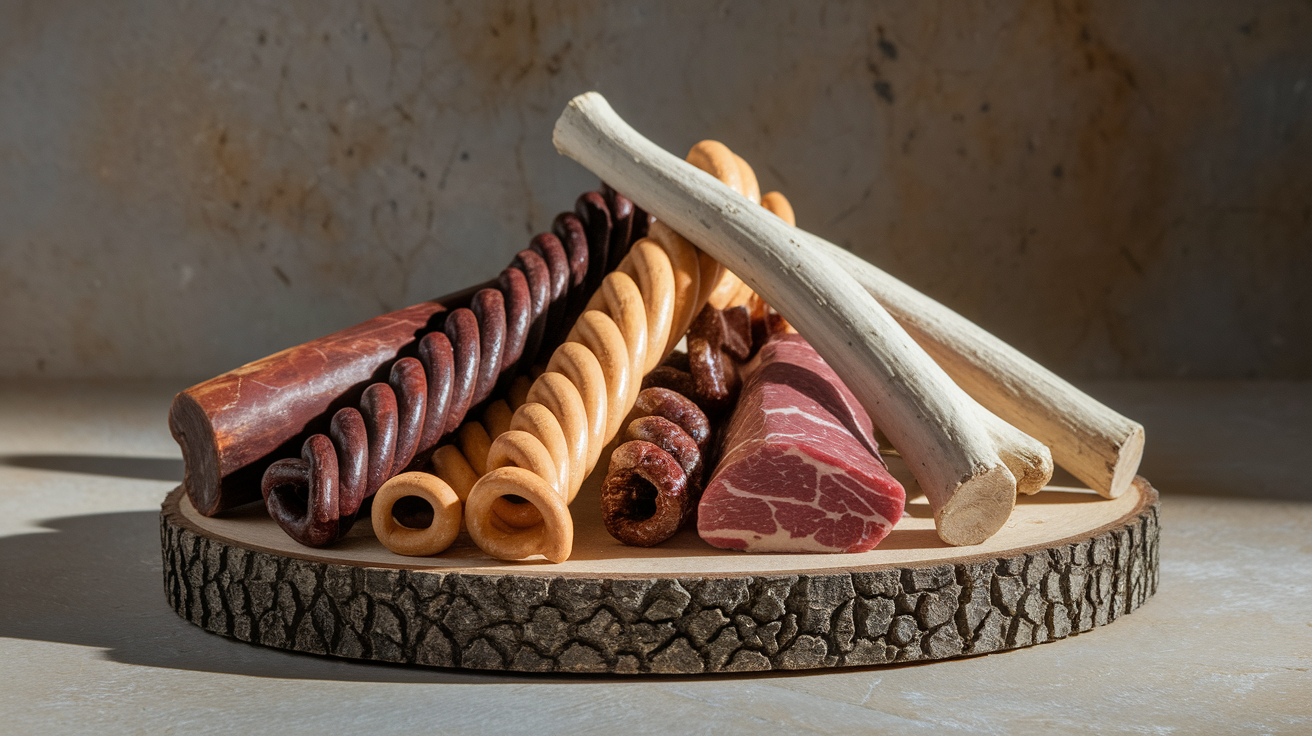
Aggressive chewers need options that last longer than ten minutes, but that durability comes at a caloric cost. A 6-inch bully stick runs you about 30 to 50 calories. An 11–12-inch braided one? You’re looking at 80 to 120 calories in a single session. Yak chews, antlers, paddywack… they’re all over the map depending on weight and moisture. Some hard chews get consumed so slowly the calorie hit per session stays manageable. Others don’t. If you’re handing these out a few times a week for 20 to 30 minutes at a time, you need to know where those calories are going, especially if your dog’s weight is already a concern.
Calorie density shifts with ingredient type, how it’s processed, and how much moisture got pulled out. Dehydrated beef products like bully sticks and paddywack pack protein and fat into a small, dense package. Antlers are shed bone, barely consumed, and add almost nothing calorie-wise even during marathon chew sessions. Yak chews fall somewhere in between: they’re hardened dairy (yak or cow milk, lime, salt), dried for weeks, and they erode slowly enough that calories trickle in rather than flood. But if you’re not paying attention, those trickles add up.
Matching the chew to your dog’s daily calorie budget means tracking two things: the total calories in the chew and how much actually gets consumed during supervised time. A small dog eating 200 calories a day can’t handle the same options as a 70-pound active dog on 1,200. You need to ask not just “Will this last?” but “What’s this session costing me?”
- Bully sticks (100% beef muscle): 30–50 kcal for a 6-inch stick, 80–120 kcal for an 11–12-inch braided version
- Paddywack (beef tendon): high protein, low fat, roughly 40–70 kcal per ounce depending on thickness
- Yak chews (hardened dairy): 60–90 kcal per ounce, slow erosion means partial consumption per session
- Antlers (shed elk or deer): minimal calorie contribution since barely anything gets consumed, mostly mechanical chewing
- Trachea and ears: moderate calorie density, softer, may get eaten faster, delivering 50–100+ kcal per piece
Nutritional Composition of Durable Chews for Aggressive Chewers

Long-lasting chews vary wildly in what they’re actually made of. Bully sticks are nearly pure protein—100% beef muscle, dried and twisted—with minimal fat and zero carbs. Paddywack, another beef tendon product, gives you that same high-protein, low-fat profile plus natural collagen. Yak chews bring something different: they’re hardened dairy, so you’re getting casein protein, small amounts of lactose (reduced during fermentation), traces of fat, and added sodium from the lime-and-salt curing process. Antlers don’t contribute digestible protein, fat, or calories. They’re bone tissue, full of calcium and phosphorus, but most of the mass stays intact and gets tossed eventually. Trachea and softer cartilage chews contain glucosamine and chondroitin alongside moderate protein and fat, making them nutritionally distinct from pure muscle options.
These differences matter if you’re managing a specific diet. A dog on a grain-free, limited-ingredient plan might handle single-ingredient bully sticks or paddywack without issue. A dog with dairy sensitivities should skip yak chews. High-protein chews fit nicely into low-fat regimens, but fatty options like pig ears or marrow-filled bones can trigger pancreatitis in sensitive dogs. If you’re managing allergies or digestive conditions, you can’t just look at durability. You need to review the guaranteed analysis and ingredient list for every chew type.
| Chew Type | Primary Macronutrient | Fat Level | Special Nutrients | Common Allergens |
|---|---|---|---|---|
| Bully Stick | Protein (beef muscle) | Low | None | Beef |
| Yak Chew | Protein (casein) | Low to moderate | Calcium, sodium | Dairy |
| Paddywack | Protein (collagen-rich tendon) | Very low | Collagen | Beef |
| Elk Antler | Minimal digestible protein | None | Calcium, phosphorus | None |
| Beef Trachea | Protein (cartilage) | Low to moderate | Glucosamine, chondroitin | Beef |
Breakdown of Calorie Density in Popular Long-Lasting Chews
Dehydration is the single biggest driver of calorie density in durable chews. When moisture drops below 10 percent, what’s left becomes a concentrated packet of protein, fat, and minerals. A fresh beef tendon might weigh 100 grams and contain 70 grams of water. After smoke-drying for weeks, that same piece weighs 30 grams and delivers the same protein and fat in a much smaller package. Yak chews get processed using a traditional Himalayan method: smoking and air-drying until they lose nearly all moisture and turn into rock-hard blocks with roughly 90 to 100 calories per ounce. Bully sticks follow a similar pattern. A 6-inch stick weighs about 1 to 1.5 ounces and packs 30 to 50 calories. A jumbo 11–12-inch braided option can weigh 3 to 4 ounces and deliver 80 to 120.
Antlers stand apart because they contribute almost no calories. They’re shed bone tissue, extremely hard, mineral-dense, nearly indestructible. Dogs gnaw and scrape the surface, wearing down their teeth more than the antler itself. Over weeks or months, tiny fragments may be consumed, but the caloric contribution is negligible. This makes antlers a zero-calorie enrichment tool, though the tradeoff is significant dental wear risk and potential for sharp splinters if the antler cracks.
Chew durability and calorie concentration don’t always align. A soft, quick-eroding chew might be low-calorie per ounce but consumed so fast that total intake is high. A dense, slow-eroding chew can be calorie-dense per ounce yet deliver fewer calories per session because only a small amount gets consumed. If you’re managing weight, you need to track both factors.
- Moisture content: Chews with less than 10% moisture concentrate calories. Those with more than 20% moisture are less calorie-dense per ounce.
- Processing method: Smoke-dried, air-dried, and freeze-dried chews are denser than baked or lightly dehydrated options.
- Material type: Pure muscle (bully sticks) and tendon (paddywack) are higher in calories per ounce than cartilage (trachea) or bone (antlers).
- Size and weight: A 1-ounce chew at 90 kcal/oz delivers 90 kcal. A 4-ounce chew at the same density delivers 360 kcal if fully consumed.
- Consumption rate: Hard chews like yak bars erode slowly, so only a fraction gets consumed per 20–30 minute session.
- Fat content: Even in low-moisture chews, fat contributes 9 kcal per gram versus 4 kcal per gram for protein, so fatty chews (marrow bones, pig ears) spike calorie density quickly.
Calorie & Nutrition Profiles of Specific Long-Lasting Chew Types
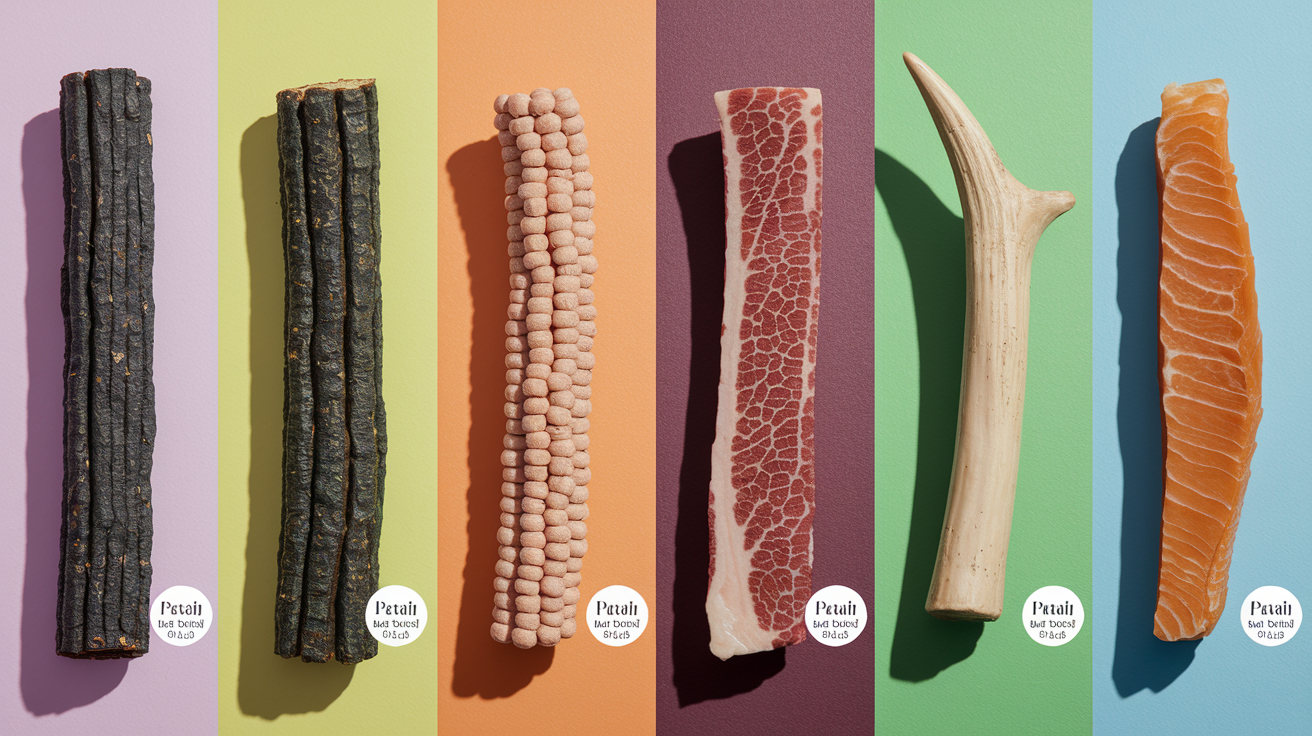
Bully Sticks
Bully sticks are 100% beef muscle (pizzle), dried and twisted into sticks or braids. A standard 6-inch stick weighs 1 to 1.5 ounces and delivers 30 to 50 calories, roughly 80 percent protein and 10 to 15 percent fat, with zero carbohydrates. An 11–12-inch braided bully stick—three smaller sticks braided together—weighs 3 to 4 ounces and provides 80 to 120 calories. The braiding increases durability, making it a better match for aggressive chewers. Bully sticks are fully digestible and don’t splinter like cooked bones, but power chewers can bite through them quickly, swallowing large pieces if unsupervised. The end softens during chewing and acts like a toothbrush, scraping plaque, but once the chew shrinks below 1 inch it becomes a choking hazard and should be removed or secured in a bully-stick holder.
Yak Chews
Yak chews are made from yak or cow milk, lime juice, and salt, then smoke-dried for weeks using a traditional Himalayan method. The result is an extremely hard, low-lactose block that erodes slowly, delivering roughly 60 to 90 calories per ounce. A typical yak chew weighs 2 to 4 ounces, so total calorie content can range from 120 to 360 calories, but aggressive chewers rarely consume an entire bar in one session. The hardness poses a tooth-fracture risk, and large chunks can break off, creating choking or obstruction hazards. When the chew gets down to about 1 inch, you can soak it briefly and microwave for approximately 45 seconds to puff it into a crunchy, safer-to-consume treat once cooled. Nutritionally, yak chews are high in protein (casein) and calcium, with moderate sodium due to the curing process.
Antlers
Elk and deer antlers are shed bone tissue, extremely dense and mineral-rich, containing calcium and phosphorus but contributing almost zero digestible calories. Dogs gnaw the surface for extended periods—sometimes weeks—but consume very little material. This makes antlers a near-zero-calorie enrichment option, though the hardness creates significant risks: tooth fractures, gum cuts, and sharp splinter shards that can puncture or lodge in the mouth, throat, or intestines. Many veterinarians recommend avoiding antlers entirely for aggressive chewers due to dental injury risk. If you use them, antlers must be sized appropriately (too small and they become projectiles, too large and dogs can’t grip them) and supervision is non-negotiable.
Paddywack (Beef Tendon)
Paddywack is dehydrated beef tendon—tough, fibrous, and extremely high in protein with minimal fat. A typical piece weighs 1 to 2 ounces and delivers 40 to 70 calories, nearly all from collagen-rich protein. Paddywack is tougher than bully sticks, making it a longer-lasting option for aggressive chewers, and it’s naturally low in fat, so it fits well into weight management or pancreatitis prevention diets. The collagen content supports joint and skin health. Like bully sticks, paddywack is fully digestible, but pieces can be bitten off and swallowed whole, so supervision and size-appropriate selection are critical.
Beef Trachea and Cartilage Chews
Beef trachea is softer than tendon or bully sticks, containing natural cartilage, glucosamine, and chondroitin, which may support joint health. A piece weighs 1 to 2 ounces and delivers 50 to 100 calories, with moderate protein and fat. Trachea chews are chewy and satisfying but erode faster than bully sticks or paddywack, so they’re better for moderate chewers or as a supplement to harder options. The glucosamine and chondroitin content makes trachea a functional chew, but the faster consumption rate means total calorie intake per session can be higher than with slower-eroding choices.
Calculating and Adjusting Daily Calories When Using Chews

Treats—including chews—should make up no more than 10 percent of a dog’s daily caloric intake to ensure balanced nutrition from complete-and-balanced food. For a 30-pound dog with a maintenance requirement of roughly 700 calories per day, that’s a 70-calorie treat budget. A single 6-inch bully stick at 40 calories fits comfortably, leaving room for training treats or a small meal adjustment. A large dog on 1,200 calories per day has a 120-calorie treat budget, so an 11–12-inch braided bully stick at 100 calories is appropriate. When chews are given a few times per week in 20 to 30-minute sessions, you need to track the calories consumed per session and subtract them from the daily kibble or wet-food portion to prevent gradual weight gain.
The challenge is that many chews don’t list calorie counts on the package. You need to weigh the chew, estimate calories per ounce based on the ingredient (bully sticks and tendon average 30 to 50 kcal per ounce, yak chews 60 to 90 kcal per ounce), and track how much is consumed versus discarded. For slow-eroding chews like yak bars, weighing the chew before and after a session provides an accurate consumption measure.
- Choose chews that fit within 10 percent of daily calories. For a 700-kcal dog, select options ≤70 kcal per session.
- Weigh chews before and after sessions to calculate actual intake, especially for slow-eroding types like yak chews.
- Reduce kibble or wet-food portions by the number of calories consumed in the chew session.
- Schedule chew sessions on the same days each week to simplify calorie tracking and meal adjustments.
- Use smaller chew sizes (6-inch bully sticks, 1-ounce paddywack pieces) for dogs on weight loss plans.
- Monitor body condition weekly. If weight creeps up, reduce chew frequency or size rather than cutting balanced food.
| Dog Weight | Daily Maintenance Calories (approx.) | 10% Treat Budget (kcal) | Example Chew + Meal Adjustment |
|---|---|---|---|
| 15 lb | 400 kcal | 40 kcal | 6″ bully stick (40 kcal) → reduce kibble by 1/4 cup (~100 kcal kibble = 40 kcal chew portion) |
| 30 lb | 700 kcal | 70 kcal | 1.5 oz paddywack (60 kcal) → reduce kibble by ~1/3 cup |
| 70 lb | 1,200 kcal | 120 kcal | 11–12″ braided bully stick (100 kcal) → reduce kibble by ~1/2 cup |
Digestibility, GI Response, and Material Safety of Long-Lasting Chews
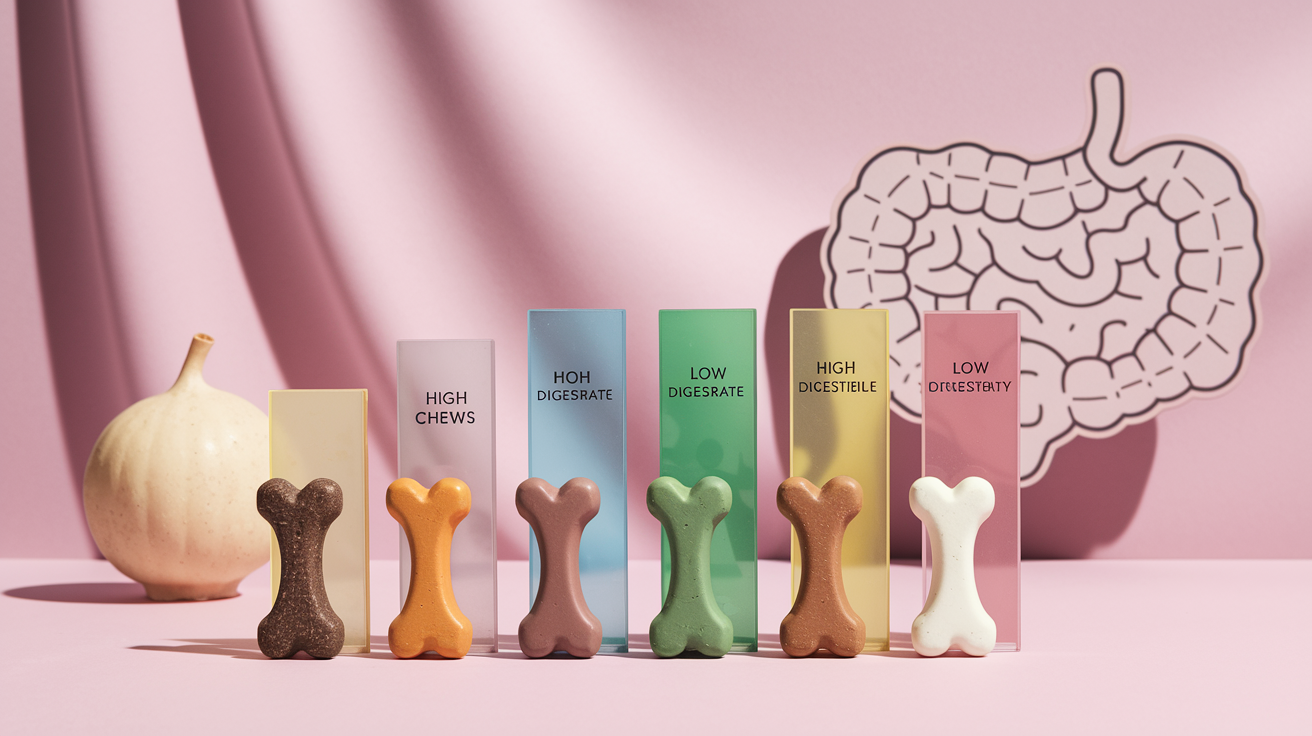
Digestibility determines how much of a chew’s weight turns into absorbed calories versus waste. Bully sticks and paddywack are nearly 100 percent digestible—everything swallowed is broken down and absorbed, so the calorie count on the package translates directly to caloric intake. Rawhide, by contrast, is poorly digestible. Large pieces can pass through the stomach undigested, creating obstruction risk and delivering fewer calories than expected, though the risk of blockage far outweighs any calorie benefit. Yak chews are moderately digestible. The hardened dairy matrix breaks down in the stomach, but large chunks swallowed whole may cause obstruction or GI upset, especially in dogs with sensitive digestion. Antlers are nearly indigestible—tiny fragments may be swallowed, but they pass through with minimal nutrient absorption, contributing almost no calories.
Fat content in chews affects GI tolerance as much as total calories. High-fat options like pig ears, marrow-filled bones, or fatty beef cuts can trigger pancreatitis in susceptible dogs, even if total calorie intake stays within range. Fat delivers 9 calories per gram, so a 2-ounce chew with 20 percent fat by weight contributes roughly 100 calories from fat alone, plus additional calories from protein. Dogs with a history of pancreatitis, inflammatory bowel disease, or chronic diarrhea should stick to low-fat chews like paddywack, bully sticks, or trachea and avoid any product with visible marrow or heavy grease.
Chewing itself burns minimal calories—perhaps 5 to 10 calories over a 30-minute session, far less than the calories in the chew. The behavioral and dental benefits of chewing are real, but chews aren’t a weight loss tool. They’re a caloric input that must be managed. Aggressive chewers who consume chews quickly absorb calories faster than slow chewers who gnaw for extended periods, so session length and supervision matter. Removing the chew after 20 to 30 minutes, even if it’s not fully consumed, helps control total intake and prevents overconsumption.
Fragmentation and accidental ingestion are the primary safety risks tied to calorie absorption. A dog who swallows a 2-inch bully-stick nub whole will absorb 20 to 30 calories, but if that piece lodges in the esophagus or intestines, the immediate danger eclipses the caloric concern. Yak chews that break into large chunks, antlers that splinter, and rawhide pieces that soften and ball up all pose obstruction risks that require emergency intervention. You need to supervise chew sessions, remove pieces smaller than the dog’s muzzle (the “1-inch rule” is a common guideline), and choose chew types that match the dog’s bite force and chewing style to minimize fragmentation.
Low-Calorie and Limited-Ingredient Chew Options for Aggressive Chewers
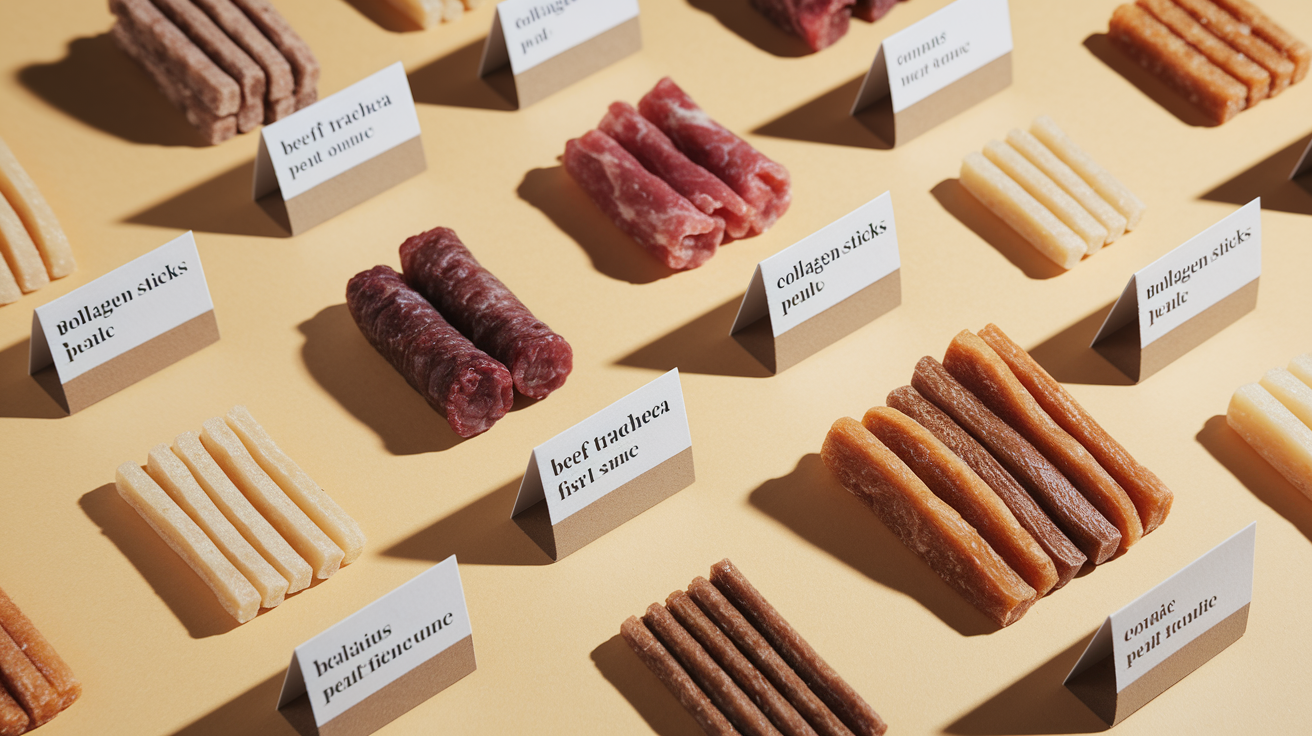
Tendon-based chews like paddywack and backstrap are among the lowest-calorie durable options, delivering 30 to 50 calories per ounce with nearly all calories from collagen-rich protein and minimal fat. These chews are tough enough to withstand aggressive chewing for 20 to 30 minutes yet remain fully digestible. Trachea and gullet chews offer similar low-fat, high-protein profiles with the added benefit of glucosamine and chondroitin, though they erode faster than tendon. Fish-skin chews provide omega-3 fatty acids and are extremely low in fat, but the strong odor and delicate texture make them better suited for light to moderate chewers rather than power chewers.
Single-ingredient chews are the gold standard for allergy-friendly, calorie-predictable options. Bully sticks (100% beef), yak chews (milk, lime, salt), and plain dehydrated tendons contain no fillers, grains, or artificial additives, making it easy to calculate calories and avoid allergens. Limited-ingredient chews reduce the risk of food sensitivities and GI upset, especially for dogs on elimination diets or with inflammatory bowel disease.
- Beef paddywack: 40–70 kcal per ounce, single-ingredient, extremely tough, safe for beef-tolerant dogs.
- Beef trachea: 50–80 kcal per ounce, contains glucosamine and chondroitin, softer but still durable.
- Fish skin rolls: 20–40 kcal per ounce, very low fat, high omega-3, strong odor limits appeal.
- Collagen sticks (beef-hide based): more digestible than rawhide, 30–60 kcal per stick, check for additives.
- Dehydrated sweet potato slices: low-calorie plant option (~30 kcal per ounce), not durable for aggressive chewers but safe for rotation.
Safety and Chews to Avoid for Aggressive Chewers
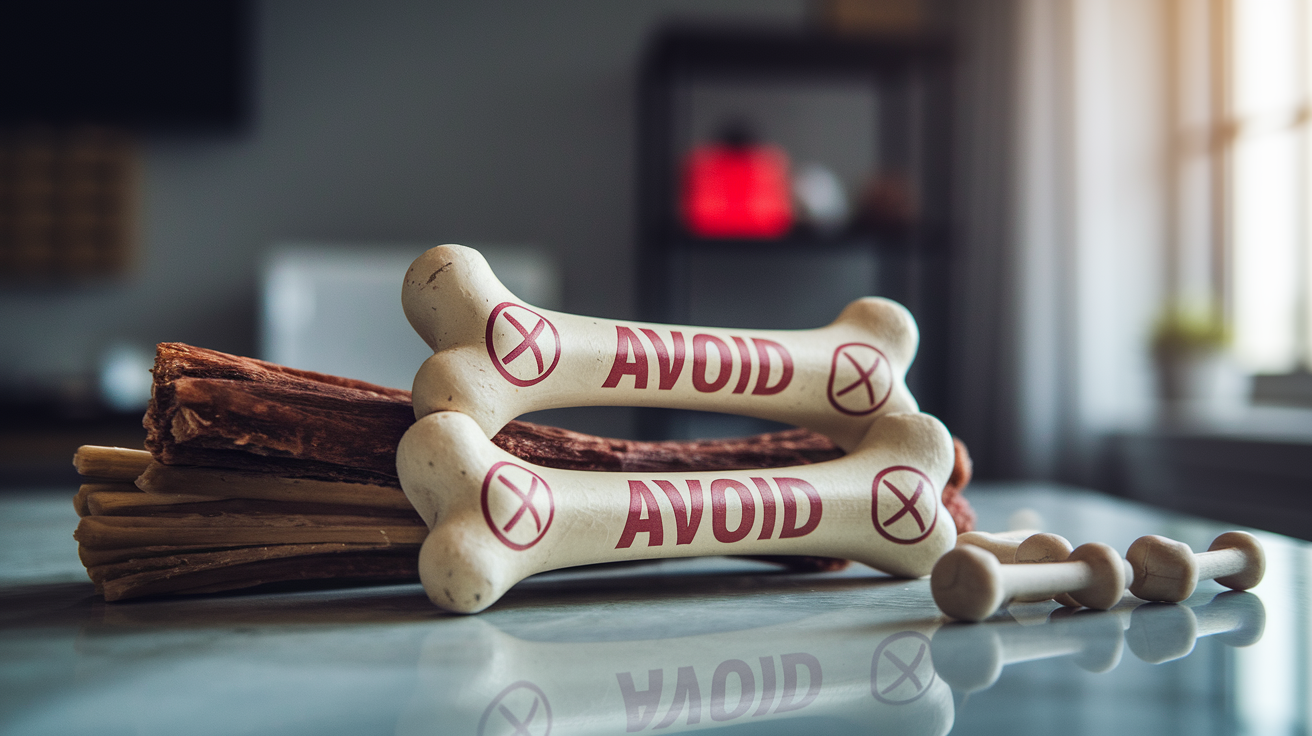
Rawhide poses the highest obstruction risk. It’s made from the inner layer of cowhide, often treated with chemicals during processing, and pieces soften into sticky, glutinous masses that are difficult to digest. Power chewers can tear off large chunks that ball up in the stomach or intestines, requiring surgical removal. Rawhide also delivers inconsistent calorie counts—often 30 to 60 calories per ounce, but because digestibility is poor, actual caloric absorption varies. Pressed or compressed rawhide products are marketed as “safer,” but they still carry the same fragmentation and obstruction risks.
Cooked bones splinter into sharp shards that can puncture the esophagus, stomach, or intestines, causing life-threatening injuries. Even large beef femur bones, often sold as “safe” chews, can fracture teeth or break into dangerous fragments when gnawed by aggressive chewers. Raw bones carry bacterial contamination risks and are controversial. They’re outside the scope of calorie-managed long-lasting chews. Cheap plastic or nylon chews marketed as “indestructible” often break into sharp pieces under heavy chewing, creating laceration and obstruction hazards without delivering any nutritional value.
Overfeeding chew treats leads to weight gain, GI upset, and nutrient imbalances. Signs include gradual weight increase (monitor body condition score weekly), loose stools or diarrhea after chew sessions, vomiting, lethargy, and reduced appetite for regular meals. If a dog refuses kibble after a chew session, the chew delivered too many calories or too much fat. Emergency signs—difficulty swallowing, drooling, retching without producing vomit, abdominal distension, or bloody stools—require immediate veterinary attention and may indicate obstruction, perforation, or pancreatitis.
- Remove rawhide and pressed rawhide from the rotation. Substitute fully digestible bully sticks or collagen sticks.
- Never offer cooked bones, marrow bones, or rib bones to aggressive chewers. The splinter risk isn’t worth the enrichment value.
- Avoid cheap plastic or nylon bones that fracture under pressure. Choose natural chews or veterinary-grade rubber toys instead.
- Supervise every new chew type for the first 15 to 20 minutes to assess fragmentation, consumption rate, and the dog’s chewing style.
- Discard chews smaller than 1 inch or smaller than the dog’s muzzle to prevent choking and obstruction.
Comparison Chart of Calories and Nutrition Across Chew Types
The table below consolidates calorie, macronutrient, and safety data for the most common long-lasting chews suitable for aggressive chewers. Calorie ranges reflect typical product sizes and moisture content. Actual values vary by brand and processing method. Digestibility is rated qualitatively (high = >90% absorbed, moderate = 50–90%, low = <50%). Recommended dog size is based on choking risk and durability needs.
| Chew Type | Size / Weight | Calories (kcal) | Protein (g) | Fat (g) | Digestibility | Recommended Dog Size |
|---|---|---|---|---|---|---|
| Bully Stick (6″) | 1–1.5 oz | 30–50 | 6–8 | 1–2 | High | Small to medium |
| Braided Bully Stick (11–12″) | 3–4 oz | 80–120 | 18–24 | 3–5 | High | Medium to large |
| Paddywack (Tendon) | 1–2 oz | 40–70 | 8–12 | 0.5–1 | High | Medium to large |
| Yak Chew | 2–4 oz | 120–360 | 24–60 | 2–6 | Moderate | Medium to large |
| Elk Antler | 4–6 oz | <5 (minimal consumption) | Trace | Trace | Low (indigestible) | Large (tooth-fracture risk for all sizes) |
| Beef Trachea | 1–2 oz | 50–100 | 10–16 | 2–4 | Moderate to high | Small to medium |
Yak chews show the widest calorie range because dogs rarely consume an entire bar in one session. Weighing the chew before and after a 20 to 30-minute session is the only way to measure actual intake. Antlers deliver near-zero calories but carry the highest dental injury risk, making them a poor choice for calorie-conscious owners who also prioritize safety. Bully sticks and paddywack offer the best balance of durability, digestibility, and predictable calorie content for weight-managed aggressive chewers.
Feeding Frequency and Chew-Use Scheduling Guidelines

Chew sessions should occur a few times per week, not daily, to prevent overconsumption and GI adaptation issues. A schedule of three to four sessions per week, each lasting 20 to 30 minutes, allows dogs to enjoy enrichment without exceeding the 10 percent treat-calorie guideline. Daily chewing can lead to calorie creep, especially with calorie-dense options like yak chews or braided bully sticks, and increases the risk of dental wear, GI upset, and nutrient imbalances from displacing complete-and-balanced food.
Hydration is critical during and after chew sessions. Dehydrated chews pull moisture from the GI tract as they rehydrate in the stomach, so fresh water must be available at all times. Some owners soak hard chews like yak bars for a few minutes before offering them to reduce hardness and choking risk, though this also softens the chew and shortens durability.
- Schedule chew sessions for the same days each week (e.g., Monday, Wednesday, Friday) to simplify calorie tracking and meal adjustments.
- Limit sessions to 20–30 minutes. Remove the chew even if not fully consumed to control intake and prevent dental overuse.
- Rotate chew types weekly to maintain interest and reduce the risk of ingredient-specific sensitivities.
- Provide fresh water before, during, and after chew sessions to support digestion and rehydration.
Selecting Chews Based on Dog Size, Age, and Caloric Needs
Size selection directly impacts safety and calorie control. A 6-inch bully stick is appropriately sized for a 15 to 30-pound dog, delivering 30 to 50 calories in a 20-minute session, while an 11–12-inch braided option suits a 60 to 80-pound dog with a higher caloric budget. Small chews given to large dogs become choking hazards. Large chews given to small dogs are wasted because the dog can’t make progress, leading to frustration and abandonment. The chew must be large enough that the dog cannot fit the entire piece in its mouth at once.
Age affects chew tolerance and calorie needs. Adolescent dogs—puppies through two years—have higher energy requirements and can tolerate more frequent chew sessions, but their adult teeth are still settling, so extremely hard chews like antlers and yak bars may cause fractures. Senior dogs often have compromised dental health, reduced jaw strength, and lower caloric needs, making softer chews like trachea, bully sticks, or lightly dehydrated tendons safer and more appropriate. A senior dog on a 500-calorie daily ration has only a 50-calorie treat budget, so smaller chew sizes and less-frequent sessions are necessary.
Activity level modulates caloric needs independent of size. A 30-pound working dog or agility competitor may require 900 calories per day, supporting a 90-calorie treat budget and allowing for an 11–12-inch bully stick a few times per week. A 30-pound sedentary senior on 600 calories per day has a 60-calorie budget, limiting options to 6-inch bully sticks, small paddywack pieces, or trachea chews. Matching chew size and type to both weight and activity level prevents calorie imbalances and supports lean body condition.
Evaluating Labels, Ingredient Lists, and Nutritional Claims on Chews
Nutritional labels on dog chews follow the same guaranteed analysis format as dog food: crude protein (minimum %), crude fat (minimum %), crude fiber (maximum %), and moisture (maximum %). These percentages describe the chew “as fed,” meaning they include moisture weight, which can be misleading. A chew with 10 percent moisture and 70 percent protein is far more calorie-dense than a chew with 40 percent moisture and 50 percent protein, even though the second product’s protein percentage looks lower. You need to calculate dry-matter basis to compare products accurately, or simply weigh chews and use per-ounce calorie estimates.
Most chew packages don’t list calorie counts, leaving you to estimate. When calories are listed, they’re often given per 100 grams or per piece, but piece weights vary widely. A “jumbo” yak chew from one brand may weigh 3 ounces. From another, 6 ounces. Reading the fine print and weighing products at home is the only way to track intake precisely. Terms like “natural,” “human-grade,” and “grain-free” lack regulated definitions in the pet treat industry, so they offer little guidance on calorie content or safety.
- Check the guaranteed analysis for moisture percentage. Lower moisture means higher calorie density per ounce.
- Look for calorie statements in kcal per piece or per 100 g. If missing, estimate using ingredient type (bully sticks ~35 kcal/oz, yak chews ~75 kcal/oz).
- Weigh the chew before offering it to calculate total calorie content. Weigh again after the session to measure consumption.
- Read the ingredient list for single-ingredient or limited-ingredient products. Avoid chews with artificial colors, flavors, or preservatives.
- Ignore marketing claims like “natural” or “human-grade” unless backed by specific ingredient disclosures and third-party testing results.
Practical Tracking and Tools for Calorie Management
A kitchen scale is the most valuable tool for calorie management. Weighing chews before and after sessions provides exact consumption data, which can then be multiplied by the chew’s calorie-per-ounce estimate to calculate intake. For example, a yak chew that weighs 4 ounces (approximately 300 kcal total) before a session and 3.5 ounces after means the dog consumed 0.5 ounces (approximately 38 kcal). That 38 kcal is subtracted from the day’s kibble portion, preventing gradual weight gain. Digital scales that measure in grams offer more precision than ounce-only models.
A feeding diary—paper or app-based—helps you track chew sessions, calorie intake, and body condition trends over time. Log the chew type, weight before and after, calculated calories, and any GI or behavioral changes. Weekly weigh-ins and body condition scoring (ribs easily felt, visible waist, tucked abdomen = ideal) provide outcome data. If weight trends upward despite calorie tracking, you’re either underest
If you’re balancing tough chews with daily calories, this post showed quick, practical ways to compare chew types and estimate kcal per session.
We walked through nutrient differences—bully sticks, paddywack, antlers, yak chews—how dehydration raises calorie density, and basic safety like 20–30 minute sessions and removing pieces under 1 inch.
Use the calorie and nutrition guide for long-lasting chews for aggressive chewers to track treats, tweak meals, and pick low-calorie single-ingredient options. Small swaps keep your dog satisfied and healthy.
FAQ
Q: What are the healthiest long-lasting dog chews?
A: The healthiest long-lasting dog chews are single-ingredient, digestible options like bully sticks, paddywack, trachea/tendon, yak chews, and antlers; choose by your dog’s chew strength, size, and tummy tolerance, and supervise.
Q: Do dog chews have calories?
A: Dog chews do have calories. Dehydrated and fatty chews pack more calories per ounce, so count chew calories toward daily intake and reduce meal portions if given often to avoid weight gain.
Q: What are the best chews for aggressive chewers?
A: The best chews for aggressive chewers are tough, long-lasting items like paddywack, thick bully sticks, yak bars, and tendons; pick appropriately large sizes, supervise closely, and retire chews that splinter or shrink below one inch.
Q: Why don’t vets like bully sticks?
A: Vets don’t like bully sticks because they can be calorie-dense, fatty, and sometimes contaminated. They may cause GI upset or weight gain if overused, so use sparingly, choose single-ingredient sources, and supervise.